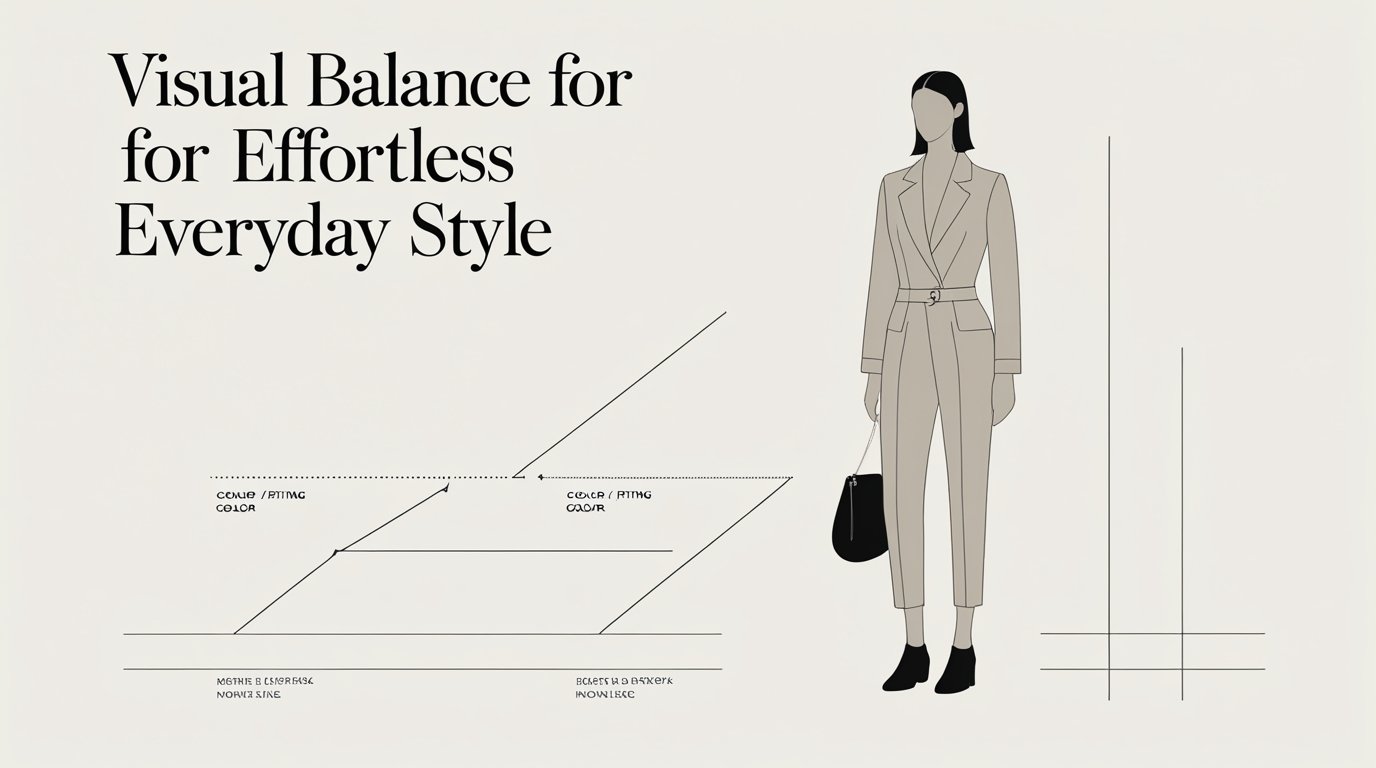
This is the “manual” I wish I had a decade ago. Back then, I believed that looking good was a matter of budget or following the latest trend report from Milan. I would buy the expensive boots, the “it” jacket, and the high-end denim, yet I would look in the mirror and feel like a kid wearing his father’s clothes. Something was always “off.” The jacket looked too heavy; the shoes looked too clunky; the colors felt like they were shouting at each other. I realized eventually that style isn’t about the items themselves, it is about Visual Balance.
Visual balance is the architectural science of how the eye perceives weight, color, and texture. When an outfit is balanced, the eye moves smoothly from head to toe. When it’s unbalanced, the eye gets “stuck” on a weirdly large shoe or a jacket that is too short. Achieving “effortless” style is actually the result of mastering these invisible ratios. In this guide, I’m going to break down every pillar of visual balance I rely on to get dressed in under five minutes every morning.
The Geometry of the Body:
Every outfit creates a shape. If you don’t control the shape, the shape controls you. Most people dress by picking clothes they like; I dress by picking the silhouette I want to project.
1. The Rule of Thirds vs. The Half-and-Half Trap:
The biggest mistake men and women make is dividing their bodies exactly in half. If your shirt ends exactly at your crotch line, you have created a 1:1 ratio. This is visually boring and often makes you look shorter.
- The Solution: I aim for a 1:2 or 2:3 ratio. By tucking in my shirt (high-waisted) or wearing a shorter jacket, I extend the line of my legs. This creates a “long” visual path for the eye, making me look taller and more balanced.
2. Managing “Visual Weight.”
Some fabrics “look” heavier than others. A leather jacket has more visual weight than a linen shirt.
- My Strategy: If I wear a “heavy” item on top, I must “ground” it with a heavy item on the bottom. You cannot wear a massive shearling coat with thin, skin-tight leggings or slim-fit suit trousers; the top will look like it’s crushing the bottom. You need a wider leg or a chunky boot to balance that upper-body mass.
The “Sandwich” Technique:
If you learn only one thing from this 15,000-word deep dive, let it be the Sandwich Rule. This is my ultimate “cheat code” for effortless coordination.
- The Formula: Match the color/texture of your top layer (hat, hair, or jacket) with your footwear.
- The Filling: Use a contrasting color for your trousers.
- Why it Works: It creates “Bookends.” When your shoes match your jacket or your hat, the eye perceives a completed circuit. It tells the observer’s brain, “This person did this on purpose.” It turns a random assortment of clothes into a “Uniform.”
The 3-Dimensional Outfit:
“Flat” outfits are the death of style. If you wear a cotton T-shirt with smooth cotton chinos and canvas sneakers, you look like a 2D drawing. To create balance, you need tactile contrast.
1. The Rough vs. The Refined:
I love pairing the “rough” (denim, corduroy, tweed, heavy knits) with the “refined” (silk, high-count wool, polished leather).
- The Move: Try a chunky cable-knit sweater with sleek, tailored wool trousers. The “weight” of the knit is balanced by the “sharpness” of the trouser crease.
2. The Shine Factor:
Balance also applies to light reflection. If you are wearing a shiny technical raincoat, balance it with matte denim. If everything is shiny, you look like an astronaut; if everything is matte, you look like you’re fading into the background.
Color Temperature and “The Neutral Anchor”
Color balance is where most people get scared. They either wear all black (safe but boring) or too many bright colors (chaotic).
1. The 60-30-10 Rule:
I stole this from interior design.
- 60% Primary Neutral: (e.g., Navy, Grey, or Black) Usually your suit or trousers and jacket.
- 30% Secondary Neutral: (e.g., White or Cream) Usually your shirt or knitwear.
- 10% Accent Color: (e.g., Burgundy, Forest Green, or Gold) Usually your tie, socks, or a pocket square. This ratio ensures that the “pop” of color doesn’t overwhelm the visual balance.
2. Tonal Layering:
This is the “Advanced” level. I’ll wear four different shades of brown, from a dark chocolate boot to a tan pair of trousers to a camel coat. The balance here comes from the gradient. By staying in the same color family, the “weight” of the outfit feels cohesive and expensive.
The “Third Piece” as a Balancer:
I never leave the house in just a shirt and pants. That is a “base layer,” not an outfit. The Third Piece is the structural element that provides balance.
- The Utility: A vest, a blazer, a cardigan, or a denim overshirt.
- The Magic: The third piece creates vertical lines down the center of your body. This “slims” the torso and adds complexity. If my trousers feel too wide, adding a structured blazer balances the bottom-heavy look by widening the shoulders.
The “Focal Point” Management:
A balanced outfit has one “hero.” If you have a hero jacket, hero shoes, and a hero hat, they are all fighting for attention. This creates “Visual Noise.”
- The Strategy: I pick my “Hero” piece first. If I’m wearing my favorite bold-patterned trousers, everything else, the shirt, the shoes, the jacket, must be “The Audience.” They should be neutral and simple. Style is about knowing who the star of the show is today.
The Foundation of Balance:
Shoes are the most important part of visual balance because they literally “ground” the outfit.
1. The “Sole” Ratio:
If you are wearing a slim suit, a chunky “Dad sneaker” will look like a clown shoe. Conversely, if you are wearing wide-leg skater pants, a slim Chelsea boot will make your feet look like toothpicks.
- The Rule: The “bulk” of your shoe should match the “width” of your pant leg opening.
2. The Color Grounding:
I generally prefer my shoes to be darker than my trousers. This creates a natural “base” for the eye. When the shoes are significantly lighter than the pants, the outfit can feel “top-heavy,” unless you are specifically using the “Sandwich Rule” mentioned earlier.
Proportions for the “Short” and “Tall”
Visual balance can be used to “correct” our natural proportions.
- For Shorter Frames: Keep the contrast between pants and shoes low. Wearing black shoes with black pants creates a “continuous line” that tricks the eye into seeing more height. Avoid long coats that end below the knee, as they “cut” your height into smaller, unbalanced segments.
- For Taller Frames: You can afford to “break” the line. Use a belt in a contrasting color to create a horizontal break. Roll your sleeves and your hems. These “interruptions” in the visual line create a more balanced, approachable silhouette for very tall individuals.
The “Occasion” Balance:
True style is also about balancing your outfit with your environment.
- The “High-Low” Blend: This is my personal favorite. I’ll wear a formal blazer with high-quality joggers and clean sneakers. The “High” (blazer) balances the “Low” (joggers). It says I’m professional, but I’m not a “stiff.” In 2025, the most stylish people are the ones who can bridge the gap between the boardroom and the street.
The Final Grams of Weight:
Accessories are the “punctuation” of an outfit.
- Scale Matters: If you have a large frame, a tiny 34mm vintage watch will look feminine and unbalanced. If you have thin wrists, a 48mm “diver” watch will look like a weighted cuff.
- The Hat/Shoe Balance: If I wear a heavy “beanie” or a wide-brim hat, I almost always wear a boot rather than a low-top sneaker. The “weight” at the very top of my head needs a substantial base to keep the vertical axis balanced.
Conclusion:
Effortless style isn’t an accident. It is the result of thousands of micro-decisions based on the principles of visual balance. By mastering your silhouette, “sandwiching” your colors, and respecting the weight of your fabrics, you turn dressing from a chore into a form of art. When you look in the mirror and finally feel “balanced,” that is when the true confidence begins. You aren’t just wearing clothes; you are wearing an architecture that tells the world exactly who you are.
FAQs:
1. What is the easiest way to fix an outfit that feels “off”?
Tuck in your shirt and check if your shoes match the “weight” of your jacket.
2. Can I wear more than three colors?
Yes, but ensure at least two of them are “Neutrals” like navy, beige, or grey to maintain balance.
3. Does the “Sandwich Rule” work for formal wear?
Absolutely; matching your tie color to your shoes or your belt is a classic formal application.
4. How do I balance a very bright “neon” item?
Surround it with dark, matte neutrals like charcoal or black to let the neon “pop” without overwhelming.
5. Should my belt always match my shoes?
In formal settings, yes; in casual settings, it’s more important that the “tone” of the leather matches.
6. What is “Visual Noise” in fashion?
It’s when too many patterns, logos, or bright colors compete for the eye’s attention simultaneously.